
Medina Previous Residents by Era
Medina has no single, continuous address roster. The current parcel record is the starting point, and the Recorder’s AVA service is a working index rather than a promised complete title search. The Medina County District Library guide supplies the bridge when an online result ends: use the Recorder’s counter indexes and the library’s microfilm and local-history holdings. A name that appears in a directory or census is evidence for that source’s date and format, not proof that every person at an address was recorded.
| Source | Years It Covers | Where Held | What It Shows |
|---|---|---|---|
| Auditor parcel and transfer record | Current portal, start year not published | Medina County Auditor | Parcel number, tax map, transfer starting point, and property facts shown in the record. |
| Recorder AVA index | Current portal, start year not published | Medina County Recorder | Recorded-document leads and parties reached through name or parcel searching. |
| Sectional and Old Section indexes | First current-volume run ends about 1954 | Recorder counter | Earlier grantor and grantee work for the relevant city or township section. |
| Medina city directories | 1948-1989 and 1992 | MCDL Family History collection | A listed name and address in the volumes that are available. |
| Federal census and local newspapers | Census released through 1950; newspapers 1830-1977 online collection | MCDL and federal sources | Household context, notices, obituary leads, and address references. |
For a recent transfer, begin with the Auditor and the Recorder. For an earlier Medina address, take the parcel, legal description, and the last verified party to the counter or the library rather than assuming an empty online result ends the trail.
Medina Previous Residents Start With a Parcel
The MCDL Historic Home Research guide starts at the Medina County Auditor property search. Search by address or owner, retain the permanent parcel number, print the Tax Map, and review Transfers for recent names and dates. Those items keep a past-address search tied to land even when an older deed uses a lot, tract, or township description instead of the modern street number. A tax mailing address may belong to an agent, estate, or another property, so it should not be treated as a statement of physical presence.
The Medina County Recorder’s land-record services are the next documentary stop after the parcel search.
The Recorder preserves instruments affecting Medina County land. Its online index helps locate documents, while the older counter indexes remain part of the local path for past residents and house history.
Medina Previous Residents in the Deed Chain
Each conveyance supplies the next name to test. The library’s Medina-specific method begins with the oldest owner reached online in the Grantee column. Find that person as a Grantor, then locate that Grantor as a Grantee to learn from whom the property was acquired. Record the party roles, deed type, transaction date, acreage, legal description, and volume or page at every turn. That trail is about title, so it may identify an estate, trust, or owner who did not occupy the property.
- Use the Auditor record to save the parcel number, Tax Map, transfer details, and current legal description.
- Search the earliest party reached online in the Recorder index, or enter the parcel number without hyphens as the MCDL guide directs.
- Open the transaction lead and note the grantor, grantee, instrument type, date, acreage, and volume or page.
- Move from the grantee’s earlier acquisition to that transaction’s grantor, repeating the crossover one deed at a time.
- Carry the last verified volume, party, and legal description to the Recorder counter when the web trail ends.
- Grantor / grantee
- The grantor transfers an interest in the document. The grantee receives that interest.
- Chain of title
- The ordered sequence of recorded transfers used to follow a parcel backward through time.
- Legal description
- The lot, subdivision, township, survey, acreage, or similar land wording in the record. It can connect an old deed when a street address cannot.
Medina Parcel Numbers Without Hyphens
Local search tip. The MCDL guide specifically tells researchers to omit hyphens when entering a permanent parcel number in the Recorder route. Keep both the display form from the Auditor and the no-hyphen form in research notes. This small variation matters because the Recorder recommends trying several search paths, and its AVA index does not offer a street-address search. A lot number from a deed can also become the better key for the older Index to Deeds & Mortgages.
Recorder staff can use that lot number to point to transactions, volume and page references, and the original deed. The method is especially helpful when Medina past residents are attached to land that has been divided, combined, or described differently across decades.
Medina Past Residents Beyond 1954
MCDL places the end of the first current-volume run at about 1954, then directs the search to the Old Section Index for the applicable city or township. This is a local handoff, not a claim that the online index has a verified beginning year. Bring the parcel number, the last found party, the legal description, and each volume/page reference to Room 117 so the staff can identify the correct sectional route.
An annexed Medina lot may require a township sectional book. Acreage can also shift because an owner held more than one portion of a lot, and an old farm can split into separate title lines. Preserve the city or township wording from each deed before deciding that two descriptions refer to the same parcel.
Older material remains available through more than one route. MCDL’s Land Records guide identifies deed-index microfilm for 1818-1923, reels 75-79, and deed volumes with fields such as date, to/from party, volume/page, recording date, township, tract, lot, and acres. The guide is an archival finding aid, so use the title on the specific reel or volume before assigning its full date label to one Medina parcel. This careful handoff can keep a past-resident search moving when the Recorder’s web result is no longer sufficient.
Medina Maps for Past Residents
A map can explain a built address without naming everyone who lived there. Medina’s verified 1911 Sanborn set has eight sheets at the Library of Congress. The research also identifies 1874 and 1897 county atlases as useful map companions. Compare the address, lot, street spelling, and legal description across those sources before carrying a modern number backward.
Historic street names add another check. A Historic Medina account describes today’s Main Street as Plank Road on an 1849 map and Shelby Street shortly before the Civil War, followed by a Main Street rename and renumbering in the late 1890s. That account is a lead for a past address, not a present-day addressing rule. Test both names against deeds, maps, and the subdivision or lot description.
Note: Maps establish streetscape and parcel context, while an owner or household still needs confirmation from a dated document or collection.
Medina Previous Residents in Directories
Deeds trace land interests, but previous residents often emerge from a dated directory, census, newspaper, obituary, or probate record. MCDL identifies Medina city directories for 1948-1989 and 1992, with a separate 1859 Williams volume and selected county directories. A volume may be alphabetical only, so ask the genealogy staff whether that edition has a street or criss-cross section before attempting an address-first search. The historical volumes are described in more detail in the Medina city directories collection.
- Choose a directory nearest the transfer, newspaper notice, or other dated event.
- Copy the printed name, address, and abbreviations exactly, after checking that volume’s key.
- Place an available directory on either side of the nearest released federal census, currently through 1950.
- Compare the dated household evidence with the parcel, deed, tax-duplicate, and newspaper trail.
The Ohio History Connection historical death resources can supply a dated research lead when a household trail reaches a death record or obituary question.
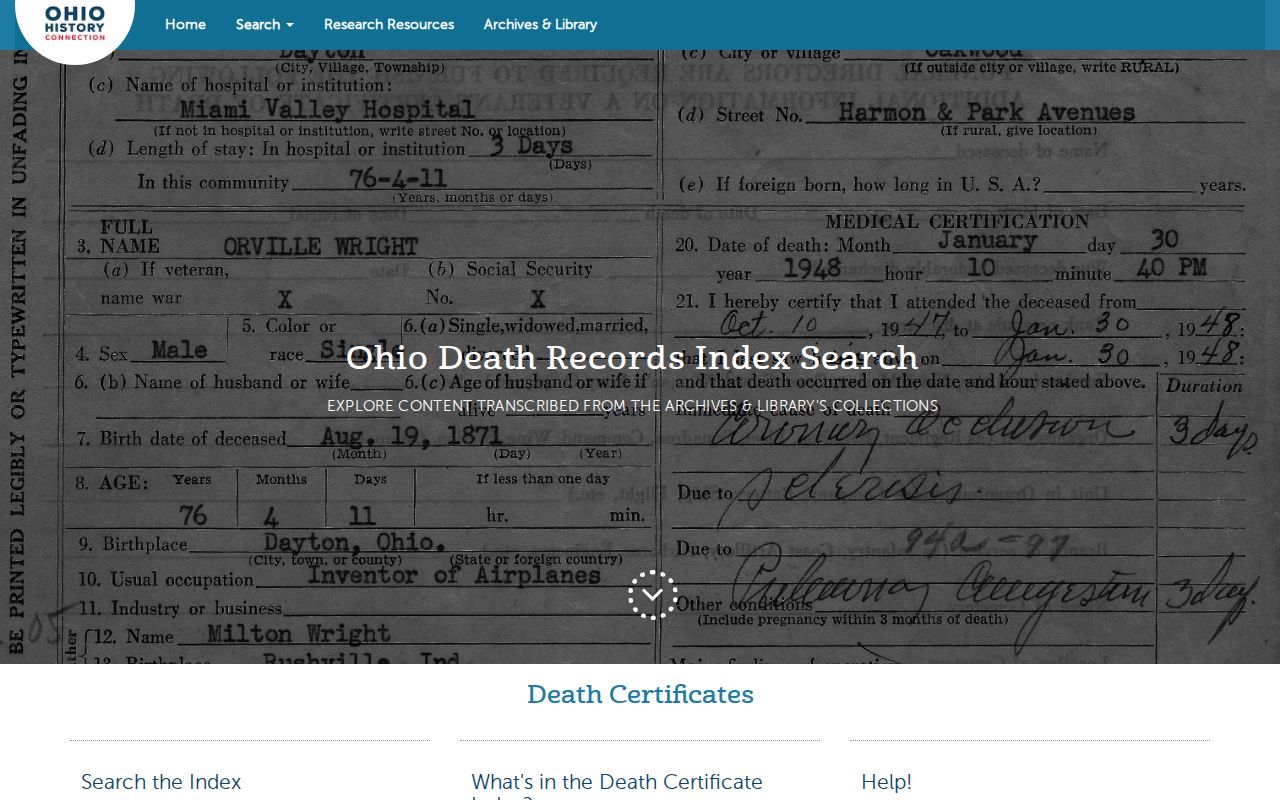
Use a death index, cemetery item, obituary, or probate file as a separate clue. None replaces the dated deed or directory evidence needed to connect a person to a particular Medina address.
Medina Land Sales and Obituaries
Some title gaps have a probate path. The MCDL Land Records guide identifies Final Record of Land Sales in Probate Court, dated 1852-1902, on reels 67-73. The records concern land sales involving incompetents, minors, or intestate parents and have alphabetical indexes by volume. That scope is narrower than a universal deed substitute, but it can explain a transfer that the ordinary chain does not.
MCDL also holds deed-index microfilm identified for 1818-1923 and actual deed-volume material. Legacy holdings elsewhere use date labels that need volume-level confirmation, so a researcher should verify the reel title before treating any range as complete. Newspapers, cemetery material, and Probate Court estate files can then test a family connection or timing question without being relabeled as property ownership. MCDL’s historical collection also includes an obituary index, local newspaper microfilm, cemetery studies, and church-history material. Those records work best as corroboration around a Medina deed date: they can suggest a death, family connection, or move, then send the researcher back to the document that records the land transfer.
Medina Previous Residents, Used Lawfully
House history and family history work best when each conclusion stays tied to a dated source and a specific parcel. Records can be incomplete, names can repeat, and the person named in a transfer may not be the person who lived at the address. Ohio’s Public Records Act, R.C. 149.43, gives a route to request public records, subject to the exemptions that protect confidential and restricted material.
Lawful use. Medina previous-resident research is appropriate for family history, house history, and personal curiosity. Do not use records to stalk, harass, threaten, or harm anyone.