
Find Medina Residents Through Records
Medina has no official master roster of every person in town. The useful route changes with the fact being checked. The Medina County Auditor connects an owner or address to a parcel. The Recorder ties recorded parties to land documents. The Board of Elections can confirm limited registration information, while the Medina County District Library preserves historical names and addresses. A court case, death record, or marriage record has its own custodian.
That distinction prevents a common mistake. Ownership, a tax mailing address, voter registration, and a person listed in an old directory are separate facts. They can support one another, but none proves every person who lives at a property. Begin with the record most closely tied to the question, preserve the spelling and dates shown, and seek a second independent match before drawing a conclusion.
- For a current property question, search the Auditor by owner, parcel number, or street components and retain the permanent parcel number.
- Use the parcel number, legal description, or party name in the Recorder’s AVA document index to locate the recorded trail.
- For a named voter, use the state or Medina County registration route only to confirm the limited status and precinct information it publishes.
- For a past household, compare the exact directory year with newspapers, census material, deeds, or probate evidence at the library or custodian.
- When a needed existing record is not online, ask the office that keeps it for inspection or a copy under Ohio’s public-records rules.
Note: A careful Medina residents directory search follows the record type, not a broad name match.
Medina Resident Record Offices
Downtown Medina concentrates several county custodians, but their files are not interchangeable. The Recorder holds permanent recorded land instruments. The Auditor holds the parcel and tax route. Courts keep their own case files, and the Board of Elections handles voter information. The City’s archive and departments are separate from county offices. A focused request names the office, existing record, person or parcel, date range, and desired format.
Medina County Recorder’s Office
144 N. Broadway St., Room 117
Medina, OH 44256
330-725-9782
Medina County Auditor
144 N. Broadway St., 3rd Floor
Medina, OH 44256
330-725-9754
Medina County Board of Elections
Local voter records and election contact
Medina County, Ohio
Use the Board’s official contact route
The address-based method belongs on the Medina by-street directory; the office map here is the starting point for choosing the right custodian.
Medina Parcel Searches Start Locally
The Medina County Auditor advanced search is the strongest current property starting point. It has separate Owner Name, Parcel Number, and address components rather than one vague address box. Its owner field is labeled “Owner Name (Last First).” An exact address can be assembled from House #, Direction, Street Name, and Street Type. The advanced choices also include municipal, township, school district, neighborhood, sale, land, and residential criteria.
| Auditor field | Search use | Format or scope |
|---|---|---|
| Owner Name | Find a tax-record owner | Expected order is Last First |
| Parcel Number | Open one identified parcel | Separate Parcel Search action |
| House # and street parts | Find a property by site address | Direction and street type are separate fields |
| Municipal / Township / Neighborhood | Narrow a property slice | Government and neighborhood fields, not postal ZIP |
The Auditor’s property-search interface shows the separate search routes used for a Medina parcel.
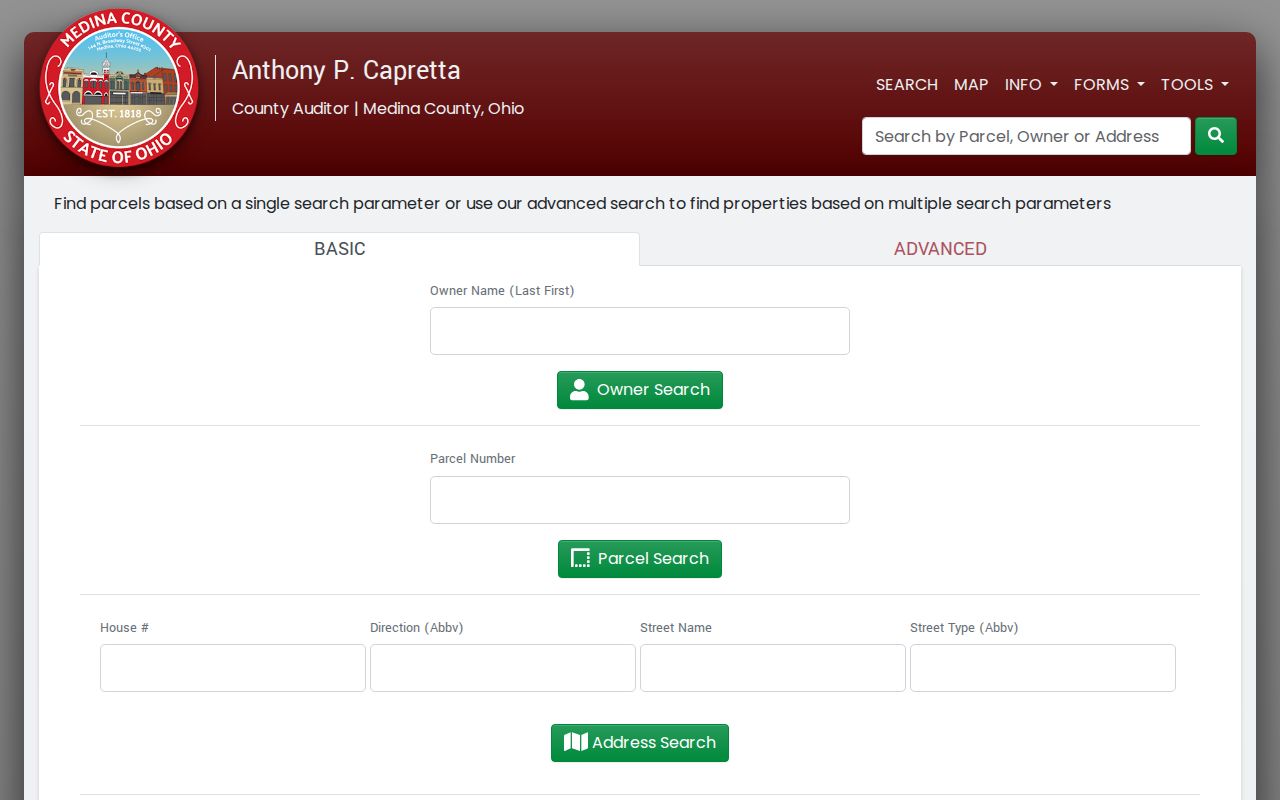
Once found, the parcel number, Tax Map, and Transfers context form a stronger bridge to recorded documents than a street name alone.
Current Medina Resident Record Sources
Each current source answers a limited question. The property roll is useful for ownership and tax context. Voter tools concern registered voters. The Recorder index lists recorded parties, not households. Court portals report public case activity. Treating any one source as a Medina residents directory would hide its limits and overstate what the custodian publishes.
| Medina source | Record it can confirm | Custodian | Access route |
|---|---|---|---|
| Auditor property roll | Parcel, owner and assessment context | County Auditor | Free public property search |
| Registration lookup | Limited registered-voter status and precinct information | Board of Elections / state | Official voter toolkit and local Board |
| AVA land index | Parties to recorded deeds and instruments | County Recorder | Working online index and counter |
| Common Pleas, Municipal, Probate dockets | Public party and case information | Separate courts | Portal or clerk/court counter |
| City archive | Municipal archival document context | Clerk of Council | View/search route; copies through custodian |
A name that appears in two independent records may be worth further checking; a single hit should be kept in its narrow context. The one-person method uses the same narrow, record-by-record approach.
Medina Voter Records Are Limited
The Ohio Secretary of State’s voter toolkit and the Medina County Board of Elections are the official starting points for registration questions. State law, principally R.C. 3503.15 and R.C. 3503.13, governs the voter list. It does not make full Social Security numbers, driver-license numbers, full birth dates, or protected-program information public. A voter result can be useful for a narrow civic verification, but it does not establish that every adult at an address is registered.
Medina County’s voter lookup is the local name-based interface documented in the research.
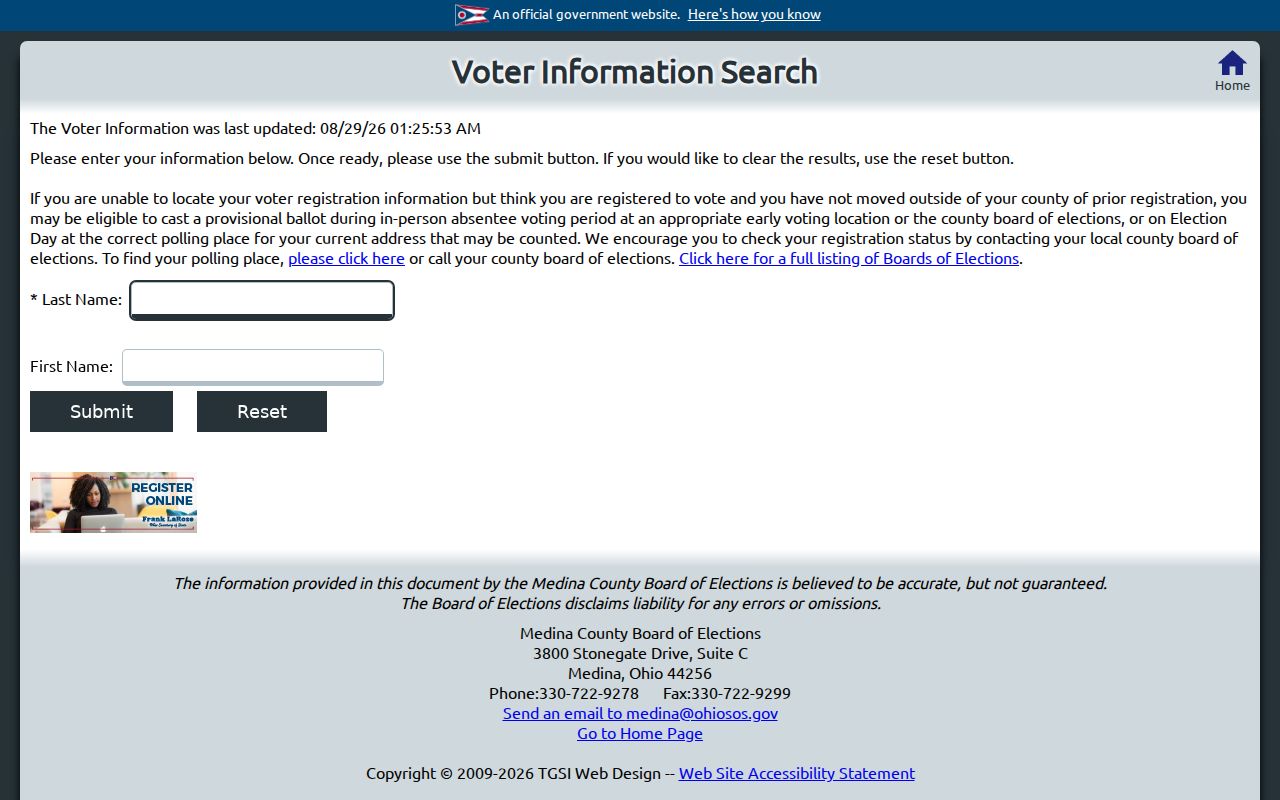
The Board also has street and report tools for election geography. Those reports remain narrower than a household list and omit protected information.
Medina Deed Indexes Follow Parcels
The Recorder calls AVA a working index for locating legal documents and recommends more than one search path. Documents generally become available the next business day after recording, but the site does not publish an online start year. AVA can search Party, First Name, Last or Business Name, date range, document number, document type, Book, Page, Parcel Number, and subdivision name, lot, or block. At least one criterion is required. It does not offer a street-address field.
That design explains the practical handoff: find the modern address in the Auditor system, retain the parcel number or legal description, then use the Recorder fields. A grantor is the party conveying an interest; a grantee receives it. An index points to a document, while the document itself supplies the legal detail. The online result is a lead, not a promise of a complete title search.
- Parcel number
- A permanent county identifier that ties a property record to map and transfer work.
- Grantor / grantee
- The conveying and receiving parties recorded in a land instrument.
- Index
- A finding tool that directs a researcher to a document or entry.
- Criss-cross directory
- A historical address-oriented directory section, if the selected volume includes one.
The Recorder’s search-options page explains its working-index purpose.
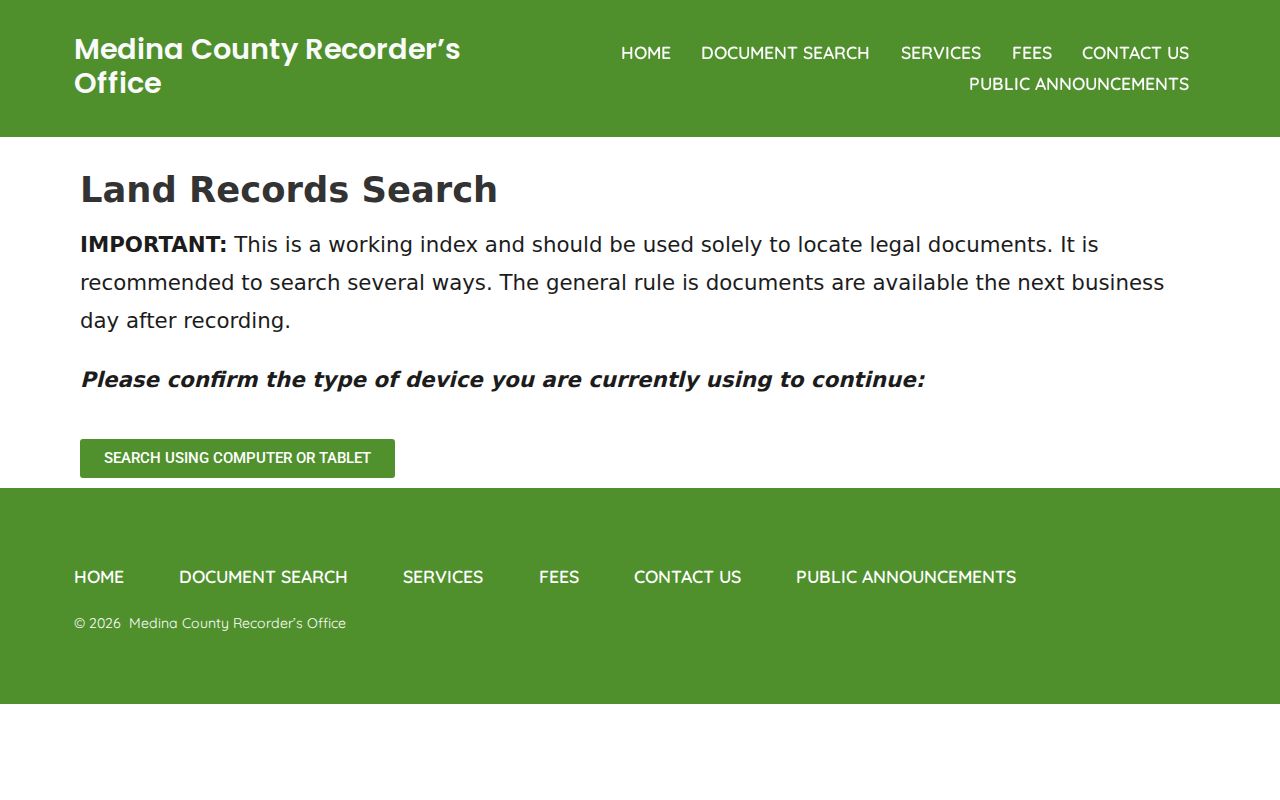
The counter retains older sectional and deed or mortgage index books identified in the library’s historic-home guide, an important fallback when a trail predates the current web path.
Medina Recorder AVA Document Trail
A recorded party name can move the search from a parcel to deeds, mortgages, plats, liens, and related instruments. Ohio R.C. 317.18 requires direct and reverse Recorder indexing, including party roles and location information such as a parcel number, lot, survey, township, or acreage. Older legal descriptions may not contain the street address now used by mail and mapping systems. Keep the document number, recorded date, party role, legal description, and parcel details together.
AVA is the Recorder’s current document-search destination.
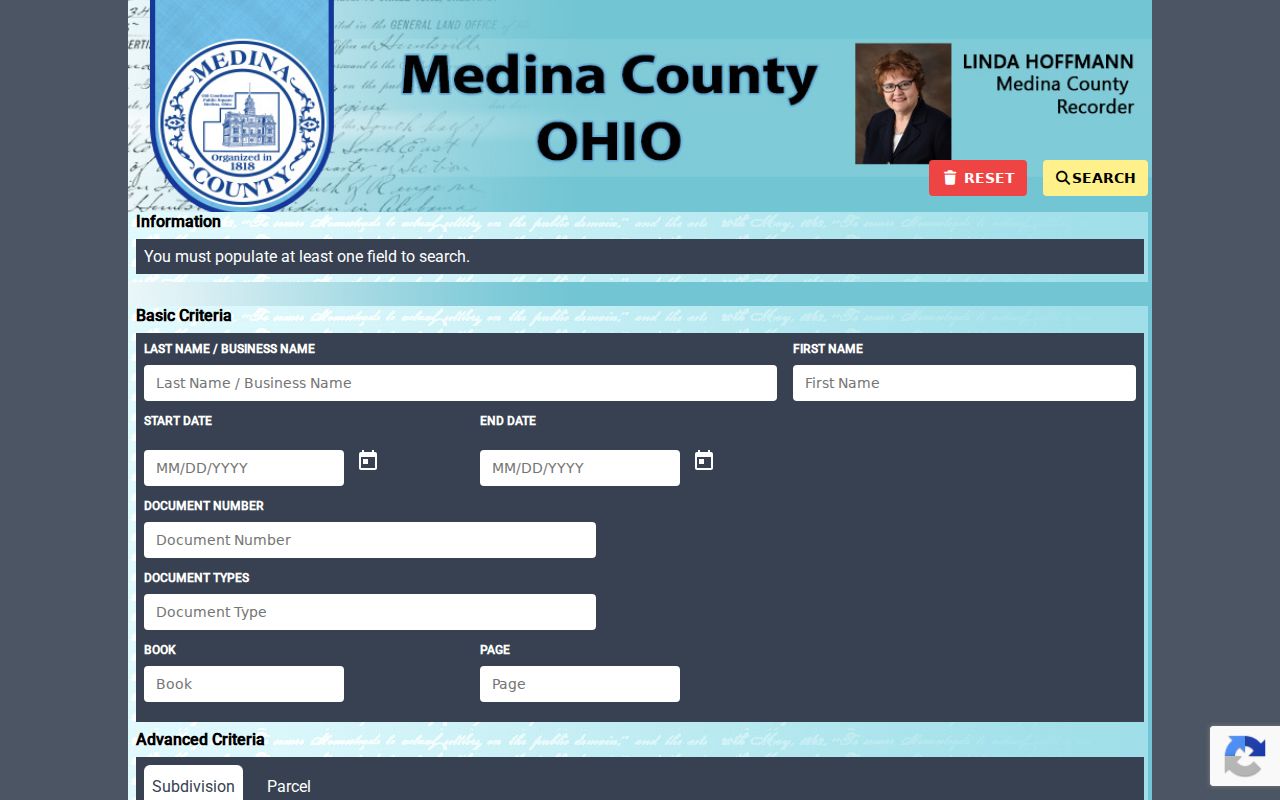
For a house-history question, MCDL advises tracing online as far as possible, then using the Recorder’s sectional, Old Section, or deed-and-mortgage indexes at the office.
Note: An Auditor mailing address or an owner-occupancy credit is not proof of present physical residence or every household member.
Medina Court Records Need the Right Court
Public case information is divided by jurisdiction. The County Clerk’s Common Pleas route covers general, criminal, domestic-relations, appellate, and auto-title work. Its Tyler portal presents Smart Search and hearing search, though the detailed form requires a JavaScript- and cookie-capable browser. Medina Municipal Court separately provides civil, criminal, and traffic case access. Probate handles estates, guardianships, marriages, and restricted adoption or juvenile matters.
The Common Pleas Smart Search landing page is one route to a public court file.
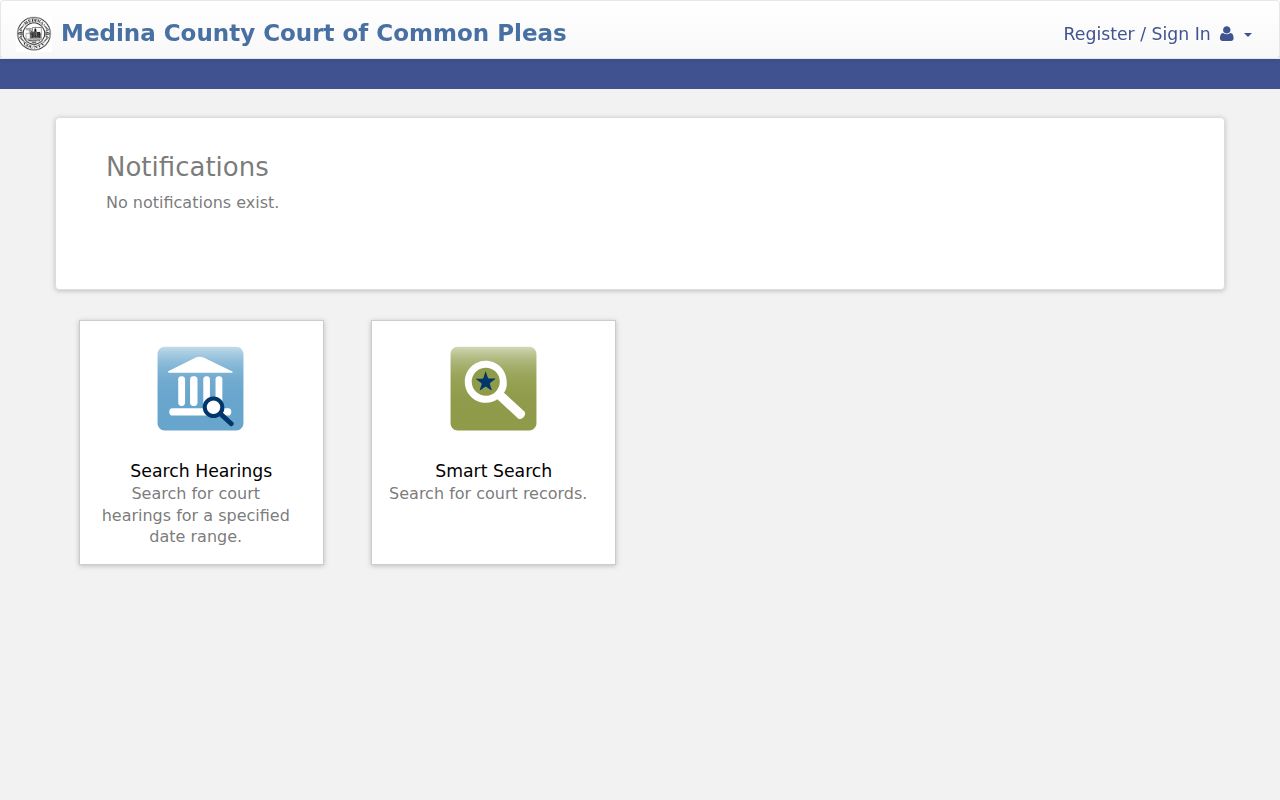
Use the clerk or court counter for an identified file when the portal does not expose what is needed. Sealed cases, juvenile matters, adoption material, and protected identifiers are boundaries, not gaps to work around.
Medina Municipal Court maintains its own official case-access route.
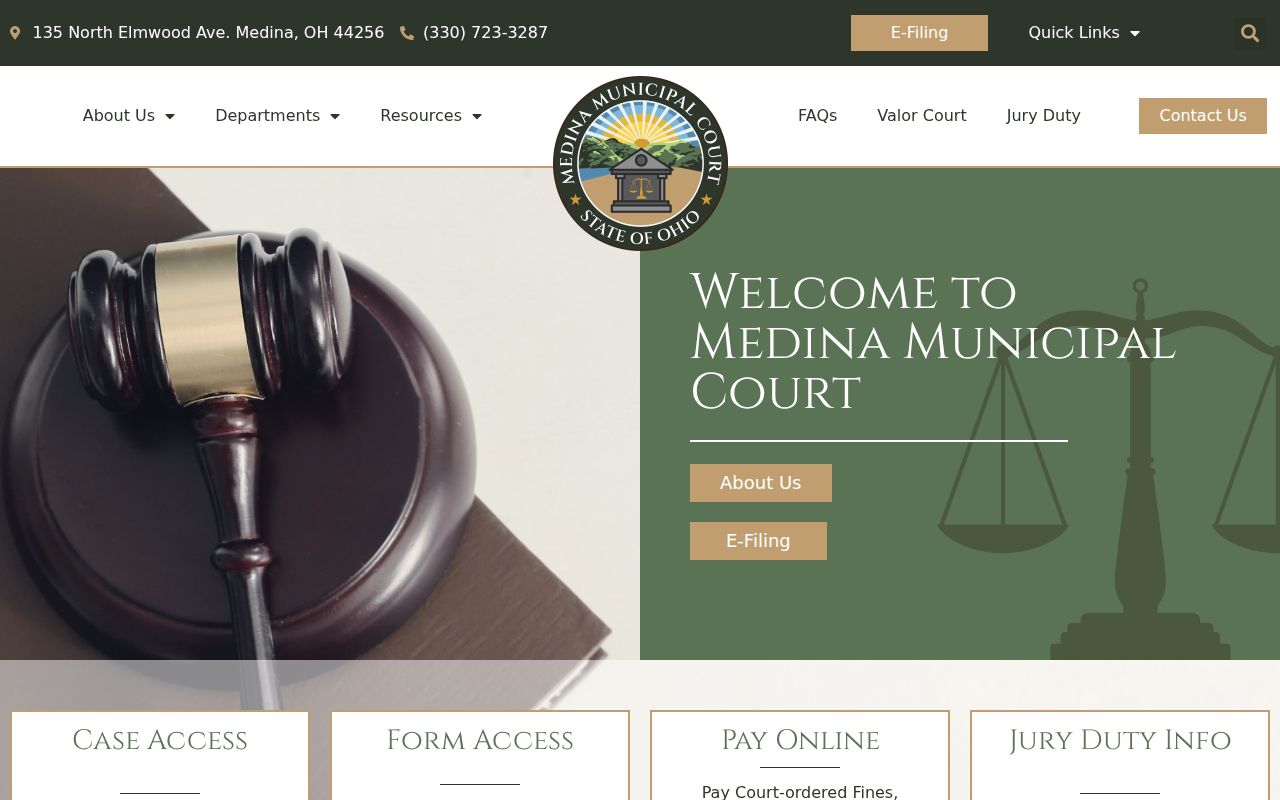
Case parties and filings can verify a public case event, but they are not proof of a current address.
Medina Vital Events Have Separate Custodians
Vital records should be requested from the actual statutory custodian. The Medina County Health Department and Ohio Department of Health are the local and state channels for certified births and deaths. The Health Department reports a $26 fee for a certified birth or death certificate. Medina County Probate Court keeps marriage licenses issued in the county; its online marriage search covers licenses after January 1, 2001, while earlier records require the court premises. A certified marriage copy is documented at $3.
Divorce decrees are held through the Clerk when granted in Medina County. Ohio History Connection’s historical death index supports genealogy, but an archival result is not a certified vital record. Adoption information uses a defined statutory channel for qualifying people, not an open name search. These distinctions keep a historic record trail accurate without turning personal events into a current-residence claim.
Note: A certificate, historical index, court docket, and library volume each have different legal and evidentiary roles.
Medina Records Requests Have a Fallback
Ohio’s Public Records Act, R.C. 149.43, is the normal route for existing records kept by public offices when a portal does not supply the document. It calls for prompt inspection at reasonable times and copies within a reasonable period. There is no universal three-business-day production deadline. An office may charge actual copy and postage costs and may require advance payment for copies.
A useful request identifies the custodian, document type, name, address or parcel, approximate date range, and whether inspection, paper, mail, or a scan is wanted. The requester need not supply identity or a purpose simply to invoke the Act. If a request is vague, the office should offer help narrowing it. A redacted partial release and a legally explained denial are meaningful outcomes when exemptions apply.
Historical Medina Resident Directories
Medina’s historical directory shelf is centered at the Medina County District Library’s Virginia Wheeler Martin Family History & Learning Center. The legacy holdings list the 1859 Williams’ Medina, Elyria and Oberlin City Directory, City Guide and Business Mirror, Medina City Directories for 1948–1989 and 1992, and Medina County Directories for 1916 and 1949–1989. A separate library description calls the city run 1948–1992 with a separate index, so a selected annual volume should be checked rather than treated as uninterrupted coverage.
Historical entries can establish a listed name or address at the volume’s date. They do not establish a present household. The fuller year-by-year collection details are available through the Medina city directories, while the library’s staff can help identify a volume, microfilm reel, or companion newspaper.
MCDL Local & Family History describes the local research center and its collections.
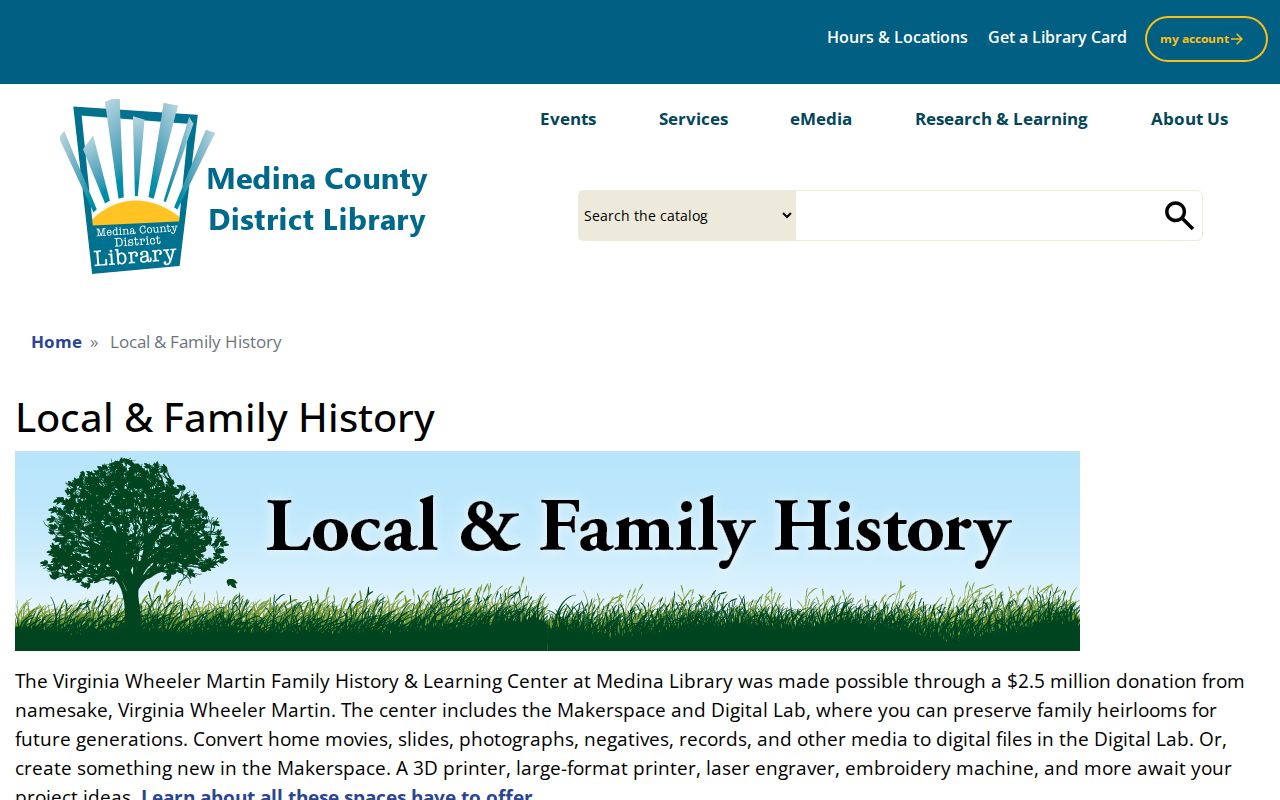
The library reports more than 1,500 local and family-history books and nearly 900 microfilm reels, creating an important in-person alternative to portal searches.
Medina’s Older Address Trail
Older Medina research requires more than copying a current street address into a modern form. The library’s land-record guide identifies deed-index microfilm and deed volumes, while the Recorder’s older sectional indexes remain part of the local method. A 1911 eight-sheet Sanborn map set at the Library of Congress, plus 1874 and 1897 county atlas references, can help reconcile the built environment with an old lot or legal description. Maps show property geography, not occupants.
Historic street names need the same care. A local historical account says present Main Street was Plank Road on an 1849 map, then Shelby Street shortly before the Civil War, and was renamed Main and renumbered in the late 1890s. Test each historic name against the parcel, lot, subdivision, or recorded description before deciding two addresses identify the same property.
Medina Property Alerts and Safe Use
The Recorder’s free Property Fraud Alert service can notify a subscriber by email or telephone when a recorded land transaction matches monitored property. It does not insure title, establish fraud, stop a filing, or replace review of the underlying document. Contact the Recorder for help with the service rather than relying on a notice alone.
The Recorder’s Property Fraud Alert page describes the local monitoring route.
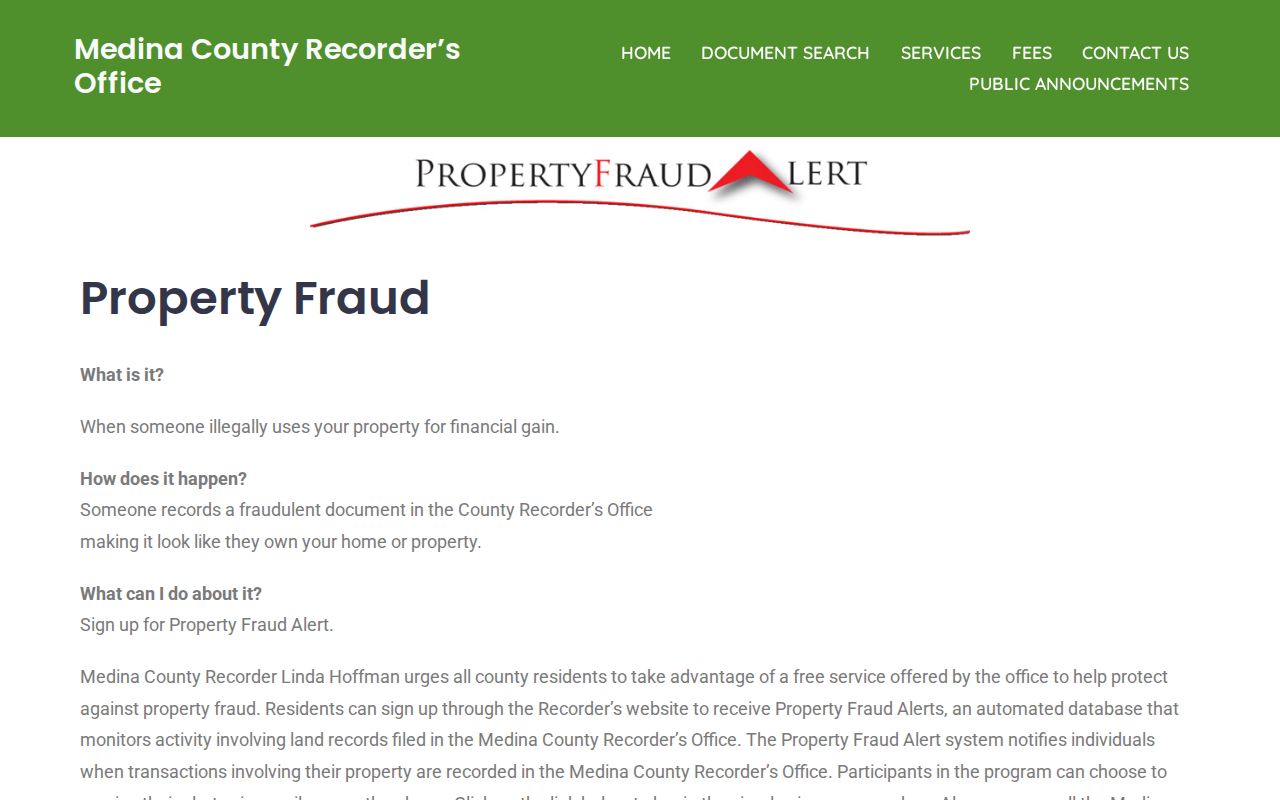
The image connects a property-safety service to the recorded-document trail, not to a claim about who occupies a home. Ohio’s June 2026 court-impostor warning also makes independent verification important: use a court’s own contact details, not a number supplied in an unexpected message.
Medina Records Have Firm Boundaries
Some useful records are not public, and some public records omit sensitive details. Ohio’s Safe at Home program permits eligible participants to use a substitute address and provides confidential voter-registration procedures. Sealed or expunged cases, juvenile and adoption records, medical information, protected voter details, and certain law-enforcement material have their own limits. DMV addresses and utility customer lists are not a shortcut when another system does not answer the question.
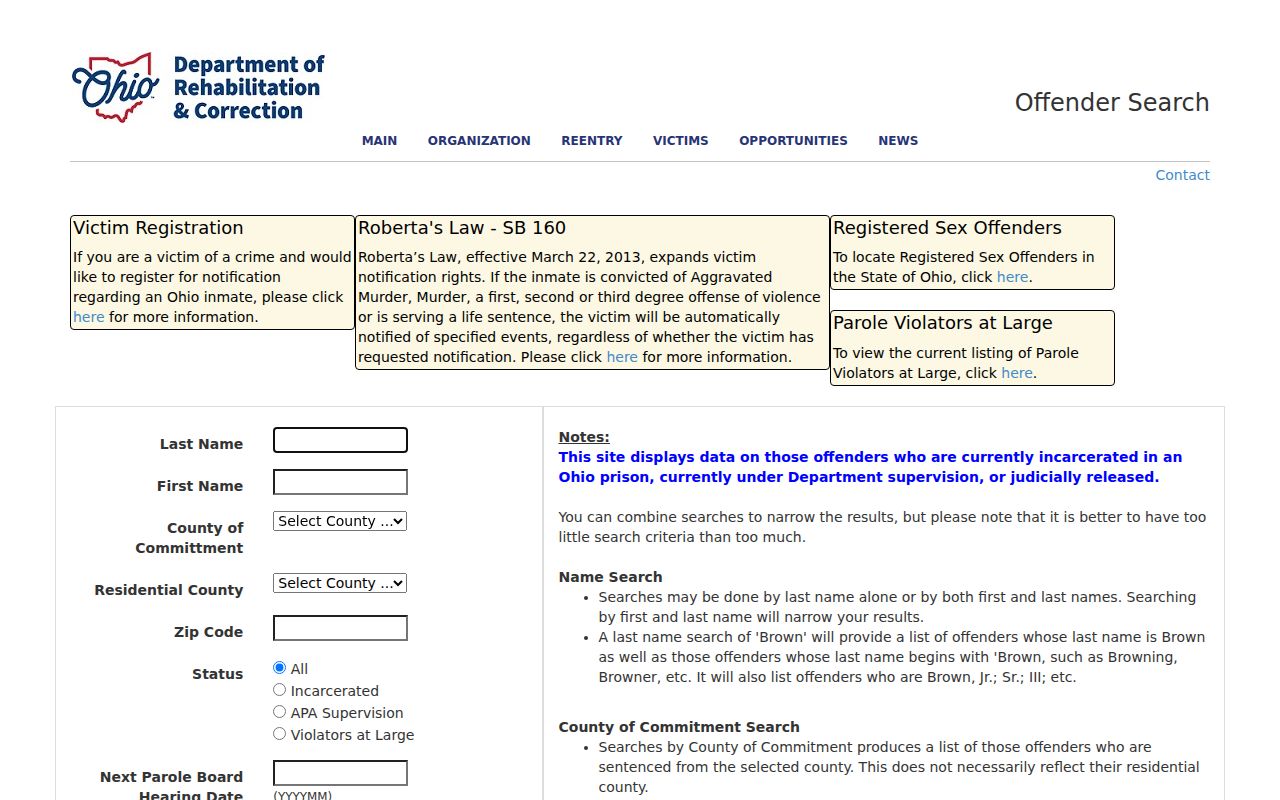
The Ohio Department of Rehabilitation and Correction offender search is a separate state custody locator, not a Medina resident list.
A returned record has the scope described by its custodian. If the official trail ends at a protected category, the responsible result is that it is not publicly releasable.